
Introduction
Hip arthroscopy has come a long way since Shigeo Suzuki et al published a case series of diagnostic arthroscopy in eight hips in 1986.1 Over the next several decades, the use of hip arthroscopy slowly shifted from diagnostic to therapeutic application. Since the early 2000s there has been an explosive growth in hip arthroscopic case volumes worldwide, with an expanding breadth of indications, tools, and techniques. This brief review provides an update on modern hip arthroscopy from three angles: indications, techniques, and outcomes.
Hip Arthroscopy Indications and Contraindications
It is important to recognize that “hip arthroscopy” refers to the arthroscopic technique of addressing conditions in and around the hip and is not always synonymous with surgery for femoroacetabular impingement (FAI), although this is its most common current use. Modern applications for hip arthroscopy include:
1. Treatment of FAI, which includes osteoplasty of the acetabulum (including the subspine region) and/or femoral head-neck junction, and treatment of chondrolabral pathology with repair, debridement, excision, or reconstruction/augmentation (Figure 1).
2. Diagnostic arthroscopy and labral treatment in setting of hip dysplasia with concomitant osteotomy.
3. Loose body removal; for example, in the setting of trauma (Figure 2).
4. Removal/biopsy of intra-articular tumors such as synovial chondromatosis and pigmented villonodular synovitis.
5. Treatment of microinstability of the hip with capsular plication or reconstruction.
6. Treatment of cartilage defects of the acetabulum with chondroplasty, microfracture, or other techniques.
7. Irrigation and debridement for septic arthritis.

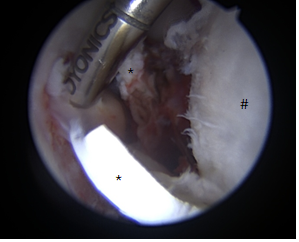
Additionally, there are case reports of techniques such as ligamentum teres debridement or reconstruction and arthroscopic-assisted acetabular fracture fixation. There are also extra-articular applications of hip arthroscopy in the peritrochanteric and ischiofemoral spaces, as well as tendon releases about the hip.
When considering hip arthroscopy for FAI—the most common therapeutic application of hip arthroscopy—patients must meet diagnostic criteria. This includes a triad of symptoms, clinical signs, and imaging consistent with hip impingement (Table 1).2 A conservative trial of activity modification, nonsteroidal anti-inflammatory drugs, and supervised physical therapy are typically first line treatments for FAI.3 In cases where diagnosis is not clear, an image-guided intra-articular diagnostic injection can be useful, and patients may opt to include cortisone with the injection for therapeutic benefit. Patients meeting diagnostic criteria for FAI with persistent symptoms despite nonoperative care may benefit from surgery with outcomes as described later in this review.
Table 1. Diagnostic Criteria of Femoroacetabular Impingement (FAI) as Published in the Warwick Agreement.2
|
Symptoms |
Clinical Signs |
Imaging Findings |
|
The primary symptom of FAI syndrome is motion-related or position-related pain in the hip or groin. Pain may also be felt in the back, buttock, or thigh. In addition to pain, patients may also describe clicking, catching, locking, stiffness, restricted range of motion, or giving way. |
Diagnosis of FAI syndrome does not depend on a single clinical sign; many have been described and are used in clinical practice. Hip impingement tests usually reproduce the patient’s typical pain; the most used test, flexion adduction internal rotation, is sensitive but not specific. There is often a limited range of hip motion, typically restricted internal rotation in flexion. |
An anteroposterior radiograph of the pelvis and a lateral femoral neck view of the symptomatic hip should initially be performed to obtain an overview of the hips, identify Cam or Pincer morphologies, and identify other causes of hip pain. Where further assessment of hip morphology and associated cartilage and labral lesions is desired, cross-sectional imaging is appropriate. |
Contraindications for hip arthroscopy for FAI are based off outcomes data that have shown high rates of failure in certain patients.4 Failure is often defined by early (within two years of surgery) conversion to total hip arthroplasty or failure to meet the minimal clinically important difference on patient-reported outcome measures. Patients with advanced osteoarthritis (Tonnis grade 2 or greater, or joint space width less than 2 millimeters on weight-bearing films) are unlikely to find symptom relief after arthroscopic intervention and may be better served with a hip replacement. Additionally, patients with hip dysplasia (lateral center edge angle under 18 to 20 degrees) should not undergo isolated hip arthroscopy as it does not address the main pathology of acetabular deficiency and can lead to increased instability and arthrosis. Older age is a relative contraindication for hip arthroscopy as each decade of life after the age of 40 results in increased rates of early conversion to arthroplasty.5 While there are no body mass index cutoffs for arthroscopic intervention, there are limitations on weight that can be safely supported on certain hip distraction beds, and a larger thigh circumference may require extra-long equipment for access.
Arthroscopic Surgical Techniques
Modern surgical techniques for hip arthroscopy have shown significant advancement in the treatment of labral pathology, osteoplasty, and capsular management.
In the early era of hip arthroscopy, treatment of labral tears consisted mainly of arthroscopic debridement. Now armed with modern arthroscopic instruments, implants, and techniques, labral repair has overwhelmingly become the most performed procedure for treatment of labral tears with at least a three-to-one rate compared to labral debridement.6 Primary labral repair can be performed using a loop configuration or a mattress configuration (labral base fixation).7 Both hardbody as well as all-suture anchors are now available with flexible insertion instruments and small footprint diameters to aid in anchor placement. In addition, both knotted and knotless options are available for hardbody and all-suture anchors. Finally, in cases when labral repair is not possible such as in the setting of a prior debridement, or an ossified labrum, labral reconstruction can be performed using autograft or allograft.8 Reconstruction can be performed in a segmental fashion or circumferential to the transverse acetabular ligament.9
In terms of arthroscopic osteoplasty, this is considered by some to be the most important part of the surgery for FAI syndrome treatment. The most common reason for revision hip arthroscopy is due to inadequate Cam deformity resection. Therefore, complete femoroplasty is necessary by utilizing intra-operative fluoroscopy to assess resection as well as a dynamic arthroscopic examination. There are now computerized applications with quantitative onlays for fluoroscopic images to aid in assessment of adequate resection to help surgeons perform this task.10 Acetabuloplasty can also be performed for pincer morphology as well as subspine impingement utilizing fluoroscopy to avoid overresection.
Multiple advancements have been made with respect to capsule management during hip arthroscopy. The most utilized capsulotomy for hip arthroscopy access is the interportal capsulotomy connecting the anterolateral portal to the midanterior or direct anterior portal. A large T-capsulotomy can also be used to with a longitudinal limb down the neck of the femur to improve exposure of Cam deformities. Recent literature has advocated for closure of the interportal or T-capsulotomy to avoid iatrogenic postoperative instability or microinstability.11 Self-retrieving and high curvature passing instruments are available to aid modern capsule repair techniques. Conservative capsule management techniques, such as the periportal capsulotomy that avoids transecting the iliofemoral ligament during hip arthroscopy access, have also been described and are increasingly utilized.12 These techniques decrease iatrogenic injury to the hip capsule and allow for postoperative capsule healing.
Altogether, advancements in hip arthroscopy have enhanced surgeons’ ability to perform durable labral repair, achieve comprehensive osteoplasty, and restore proper capsular integrity.
Hip Arthroscopy Outcomes
With improvements in surgeon ability, as well as the surgical techniques performed in hip arthroscopy in general, patient-reported outcomes and ability to return to sports have become quite good for modern hip arthroscopy. While techniques continue to improve, and while there are many areas of controversy, the one thing that most sports medicine and hip arthroscopy surgeons can agree upon is that hip arthroscopy, when properly indicated, works well. Hip arthroscopy has matured to the point where 10-year follow-up studies are now appearing in the literature. Nho et al reported their “modern hip arthroscopy” 10-year follow-up data in The American Journal of Sports Medicine (AJSM) in 2024.1 The authors equated “modern hip arthroscopy” to repair of the chondrolabral junction, osteochondroplasty, and capsular closure. The follow-up criteria was met by 94 patients, with a mean age of 34.3 and the cohort reported significant improvement in all patient-reported outcomes, including Hip Outcome Score – Activities of Daily Living (HOS-ADL), Hip Outcome Score – Sports Subscale (HOS-SS), modified Harris Hip Score (mHHS), International Hip Outcome Tool-12 (iHOT-12), and visual analog scale (VAS) for pain and satisfaction.13 The majority (at least greater than 70%) of patients reached minimal clinically important difference and patient acceptable symptomatic state (PASS) for the aforementioned outcomes.
The same group expanded their 10-year data by comparing outcomes between adolescents (ages 10 to 19) and (>20 years) at 10 years.14 In this 2025 AJSM study, they matched 50 adolescent patients to 50 adults, with a mean follow-up of 10.4 years. While there were no preoperative differences amongst the cohorts, the adolescent patients achieved greater 10-year patient-reported outcome satisfaction scores compared to adults for all the aforementioned outcomes. They also achieved a higher rate of PASS (98% vs. 79%) than adults. This demonstrates that not only is hip arthroscopy a viable option for our adult patients, but also for our youngest and most active patient populations.
But what about the long-term results in athletes? An additional AJSM study from Domb et al reported on 189 hips in 177 athletes with a mean follow-up of 127.2 months. Survivorship was reported at 85.7%; however, it is important to note that there were both labral repair and labral debridement subgroups within this cohort.15 The authors did report that debridement patients failed required hip arthroplasty sooner than labral repair patients. Quesada-Jimenez at al investigated return to sports for soccer athletes following hip arthroscopy at a minimum five-year follow-up.16 The study included 74 patients with an average age of 22.4 years. Once again, patients did very well with regards to patient-reported outcomes with significant improvement in mHHS, NAHS, HOS-SSS, iHOT-12, and VAS pain. Of 54 patients who attempted return to sport, 47 (87%) were successful, and 32 (68%) continued playing five years postoperatively.4 Overall, these results are highly encouraging, even among the most elite athletic patients. Current hip arthroscopy techniques have ultimately been proven both safe and effective; however, much still needs to be learned regarding optimal management of FAI. Questions such as the optimal management of borderline dysplasia, post versus postless hip arthroscopy, capsular management, and ideal physical therapy protocols remain, but it is clearly evident that modern hip arthroscopy is of benefit to our patients who present with symptomatic labral pathology that has failed conservative management.
Conclusion
The contemporary era of hip arthroscopy represents a significant leap forward from prior practice. Modern evidence-based indications and contraindications for surgery as well as innovations in surgical techniques and instrumentation have led to improved outcomes for patients. The future is bright for this developing field of arthroscopic surgery.
References
- Suzuki S, et al. Arthroscopic diagnosis of ruptured acetabular labrum. Acta Orthop Scand. 1986;57:513-515.
- Griffin DR, et al. The Warwick Agreement on femoroacetabular impingement syndrome (FAI syndrome): an international consensus statement. Br J Sports Med. 2016;50:1169-1176.
- Lynch TS, et al. Best Practice Guidelines for Hip Arthroscopy in Femoroacetabular Impingement: Results of a Delphi Process. J Am Acad Orthop Surg. 2020;28 81-89.
- Spencer AD, Hagen MS. Predicting outcomes in hip arthroscopy for femoroacetabular impingement syndrome. Curr Rev Musculoskelet Med. 2024;17:59-67.
- Yao JJ, et al. What is the survivorship after hip arthroscopy for femoroacetabular impingement? A large database study. Clin Orthop Relat Res. 2020;478:2266-2273.
- Cevallos N, Soriano KKJ, Flores SE, Wong SE, Lansdown DA, Zhang AL. Hip Arthroscopy Volume and Reoperations in a Large Cross-sectional Population: High Rate of Subsequent Revision Hip Arthroscopy in Young Patients and Total Hip Arthroplasty in Older Patients. Arthroscopy. 2021;37(12):3445-3454.e1.
- Sawyer GA, Briggs KK, Dornan GJ, Ommen ND, Philippon MJ. Clinical Outcomes After Arthroscopic Hip Labral Repair Using Looped Versus Pierced Suture Techniques. Am J Sports Med. 2015;43(7):1683-1688.
- Mowers CC, Childers JT, Lack BT, Hus AS, McKinley MT, Jackson GR, DeFroda SF. Allografts and Autografts in Primary Hip Labral Reconstruction Result in Improved Postoperative Outcomes, With Autografts Showing Lower Revision and Complication Rates: A Systematic Review. Arthroscopy. 2025;41(11):4839-4857.
- Orner CA, Patel UJ, Jones CMC, Giordano BD. Segmental and Circumferential Acetabular Labral Reconstruction Have Comparable Outcomes in the Treatment of Irreparable or Unsalvageable Labral Pathology: A Systematic Review. Arthroscopy. 2022;38(4):1341-1350.
- Looney AM, Wichman DM, Parvaresh KC, Alter TD, Nho SJ. Intraoperative Computer Vision Integrated Interactive Fluoroscopy Correlates With Successful Femoroplasty on Clinic-Based Radiographs. Arthroscopy. 2021;37(11):3371-3382.
- Safran MR. Microinstability of the Hip-Gaining Acceptance. J Am Acad Orthop Surg. 2019;27(1):12-22.
- Chambers CC, Monroe EJ, Flores SE, Borak KR, Zhang AL. Periportal Capsulotomy: Technique and Outcomes for a Limited Capsulotomy During Hip Arthroscopy. Arthroscopy. 2019;35(4):1120-1127.
- Allahabadi S, Chapman RS, Fenn TW, Brusalis CM, Kaplan DJ, Nho SJ. Hip Arthroscopic Surgery With Chondrolabral Refixation, Osteochondroplasty, and Routine Capsular Closure for Femoroacetabular Impingement Syndrome: Clinical Outcomes at a Minimum 10-Year Follow-up. Am J Sports Med. 2024;52(1):24-33.
- Danilkowicz RM, Vogel MJ, Kazi O, Cotter EJ, Nho SJ. Minimum 10-Year Outcomes of Adolescents Undergoing Contemporary Hip Arthroscopic Surgery for Femoroacetabular Impingement Syndrome: A Propensity Score-Matched Analysis. Am J Sports Med. 2025;53(9):2198-2207.
- Domb BG, Annin S, Monahan PF, Lee MS, Jimenez AE, Maldonado DR. Ten-Year Survivorship, Outcomes, and Sports Participation in Athletes After Primary Hip Arthroscopy for Femoroacetabular Impingement Syndrome. Am J Sports Med. 2023;51(9):2383-2395.
- Quesada-Jimenez R, Strok MJ, Schab AR, Becker N, Kahana-Rojkind AH, Domb BG. Hip Arthroscopy for Femoroacetabular Impingement Syndrome and Labral Tears in Competitive Soccer Players Shows Significant Functional Improvement and High Return-to-Sport Rates at Mid-Term Follow-Up. Arthroscopy. 2025:S0749-8063(25)00502-X.