

The following article is sponsored by Smith+Nephew
While the past two decades have seen iterative improvements in rotator cuff repair fixation (such as material options and suture configurations), larger improvements have not been realized, unlike other orthopaedic procedures.1-11
The TENDON SEAM System’s continuous-stitch construct represents the next generation of rotator cuff fixation, providing superior biomechanical performance, supporting outcomes and reducing procedural complexity in an all-in-one device.12-19
Repair Failure and Long Recovery Have Been Normalized
Traditional repairs have failure rates averaging 20 to 40%1, while several weeks of shoulder immobilization are often required2 (versus up to 5% and two weeks for other orthopaedic procedures).3-10
The reality of transosseous equivalent (TOE) repairs is that the construct is unable to carry loads generated by the native tendon (302 Newtons).13,14,19 The limited fixation points isolate loads within a small area, which may cause ‘cheese wiring’, with sutures running parallel to tendon fibers and loads transferred laterally to softer bone.13,14,16,17
In this repair environment, many surgeons favor a long period of patient immobilization (often six weeks2) until healing has sufficiently progressed to avoid structural failure, which can prevent patients from returning to everyday activities.
Due to the limitations of traditional repair methods, repair failure and long recovery have become an accepted reality in rotator cuff surgery. This unmet need formed the basis of the design philosophy for the TENDON SEAM construct.
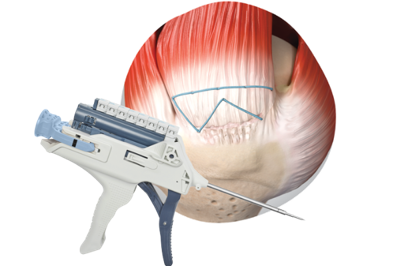
Understanding the Construct
The unique continuous-stitch construct uses small 2 x 10 mm PEEK micro-anchors delivered via an all-in-one delivery device, offering a reproducible, low profile and knotless repair built for superior biomechanical performance.*12-18
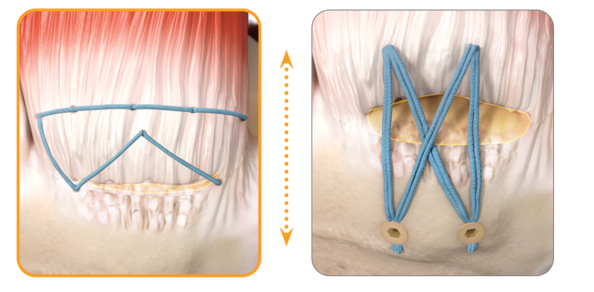
Leveraging the load-sharing principles of a seat belt, multiple independently locked fixation points are placed 5-10 mm apart across the rotator cuff footprint. The perpendicular medial seam carries the primary repair load, while a lateral zig-zag of anchors provides broad footprint compression.12,15
Combined, the TENDON SEAM Construct creates a strong and stable repair across the footprint to aid enthesis restoration, support patient recovery and optimize tendon healing.*12-19
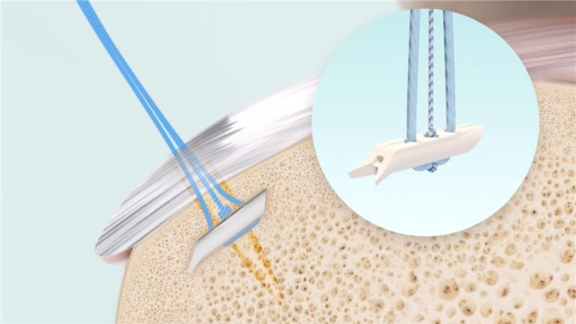
Superior in Biomechanical Testing
In biomechanical testing, the continuous-stitch construct offered two times the strength of historical rotator cuff repair constructs,12-15 providing a yield strength of 610 Newtons. This compares to 260 Newtons or 183 Newtons reported for knotted or knotless TOE rotator cuff repairs, respectively.13,14*
Additionally, the TENDON SEAM System’s 10 times less gap formation*12-14 signifies a more stable repair than historical methods have previously provided (0.33 mm gap formation after 30 cycles at 180 Newtons with TENDON SEAM versus 3.74 mm and 8.10 mm with knotted and knotless TOE, respectively).12-14
Impact on Tendon Healing and Patient Recovery
Superior biomechanical strength and gap formation minimization offer a solid foundation for tendon healing and patient recovery.12-17
Early clinical results with the TENDON SEAM System construct in rotator cuff repair are promising. Using a progressive rehabilitation protocol, median sling time was reduced to two-and-a-half weeks (from six weeks common with traditional repair2) with low clinical failure rates.**17
Streamlining the Procedure With 45% Fewer Steps
In another departure from traditional repair conventions, the TENDON SEAM System’s all-in-one device pairs superior biomechanical performance with a reduction in both procedural steps and portal entries.***12-18
Compared with knotted TOE repairs, the TENDON SEAM System reduces the number of procedure steps by 45%.18 Additionally, the construct is created through a single portal, providing a ~97% reduction in portal entries compared with knotted TOE repairs.18
Once repair steps are mastered, the ergonomic delivery device containing up to eight preloaded anchor cartridges offers reproducibility in a less complex procedure than traditional methods.18
The Future Standard of Care
The impact of the TENDON SEAM Construct on improving strength and minimizing gap formation,*12-16 and the associated influence on healing and patient recovery, directly addresses existing limitations in TOE repairs, equipping surgeons to achieve the repair they want for their patients in a streamlined procedure.
For the first time in decades, tendon repair technology now seeks to fully catch up with patient demands and surgeons’ goals to continually improve rotator cuff repair outcomes.12-19
Register for an upcoming webinar to learn more about the TENDON SEAM System by clicking this link, or by scanning the QR code below.

*Based on biomechanical testing in human cadavers. Gap formation testing: 30 cycles at 180 Newtons vs Tendon reported findings for Knotless and Knotted TOE repairs.
**Early clinical experience in a single-surgeon consecutive series; n=130. At four-to-17-month follow-up.
***Compared to traditional repair methods.
References
- Young BL, et al. JSES Rev Op Tech. 2023;3:318e323.
- Sciarretta, et al. SICOT-J. 2023;9:14.
- Ochen Y, et al. BMJ. 2019;364:k5120.
- Yee TJ, et al. J Spine Surg. 2020;6(1).
- El-Desouky II, et al. J Orthop Surg Res. 2021;16:679.
- Khan M, et al. Bone Joint J. 2016;98-B(1 Suppl A):105-12.
- Xiang Z, et al. J Orthop Surg.2021;29(3).
- Watkins RG, et al. Orthop J Sports Med. 2018;6(6)
- Denis M, et al. Phys Ther. 2006;86(2):174-185.
- Kaseb MH, et al. Int Orthop. 2022;46:1749-1759.
- Dey Harza RO, et al. Orthop J Sports Med. 2021;9(12):23259671211050899.
- Integrity Orthopaedics Data on File. Testing Report: DN-00664.
- Busfield BT, et al. Am J Sports Med. 2008;36(5):901-906.
- Park MC, et al. J Shoulder Elbow Surg. 2007;16(4):469-476.
- Integrity Orthopaedics Data on File. Testing Report: DN-00868.
- Abtahi AM, et al. World J Orthop. 2015;6(2):211-220.
- Dr Frix JT. Presentation at Orthopaedic Summit (OSET); September 19-21st 2025; Las Vegas, NV.
- Smith+Nephew 2026. Memo – Design and Tech Claims Rationales. Rev 02.
- Burkhart, et al. Arthroscopy, 2000;16(1):82-90.