Introduction
First-time patellar dislocation (FTPD) presents a challenge for athletes who are both in and off season. Patellar dislocation accounts for approximately 2% to 3% of all knee injuries with a reported incidence of six to 23 cases per 100,000 people in the general population each year. However, rates rise to 29 to 104 cases per 100,000 in people who are aged 10 to 17, especially in the athletic population.1 After a FTPD, the chance of recurrent dislocation ranges from 15% to over 50% with concern being that recurrent patellar dislocation leads to more significant soft tissue and coronal damage.2 For any team physician, athletic trainer, or healthcare providers involved with team management, navigating FTPD’s in athletes is a regular part of any given season in a variety of individual and team sports. While some data and evidence support operative treatment for those with a combination of underlying risk factors, our foundational approach to FTPD without chondral injury—even for athletes engaged in high-risk activities—remains an active supervised trial of non-operative management with acquisition of individualized performance data to guide return to high-risk activities.
Initial Evaluation
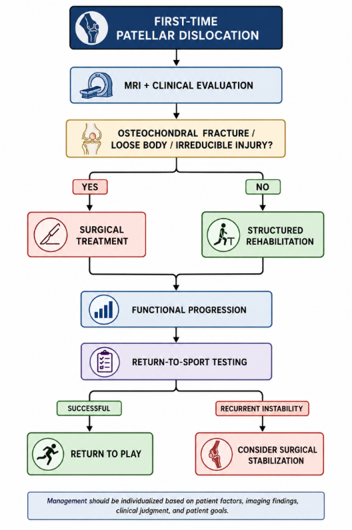
When an athlete presents with a FTPD, it is important to consider mechanism of injury, the physical exam, and any associated injuries. Current standard of care for athletes warrants obtaining an early magnetic resonance imaging (MRI) following a FTPD to rule out presence of a loose body or osteochondral fracture fragment.3,4 If a loose chondral body is present, current consensus and evidence supports discontinuing sports participation and early surgery with loose body removal, medial patellofemoral ligament reconstruction, and appropriate associated interventions.5 Other indications for early surgery for a FTPD certainly includes irreducible dislocation, disruption of the extensor mechanism such as an associated quadriceps patellar tendon injury, or the presence of a large displaced osteochondral fragment that requires open reduction internal fixation. However, in many cases, most athletes who experience a first-time traumatic dislocation present with no loose body and demonstrate a stable reduction. Conservative treatment remains the standard of care in uncomplicated first-time dislocations, regardless of the patient's involvement in high-risk athletics and sports (Figure 1).4,6,7
Conservative Treatment = Active Management
Conservative management is not the same as benign neglect. Specifically in sports medicine and the management of athletic injuries, a supervised, outcomes-based, actively managed protocol is necessary, appropriate, and the safest strategy for helping athletes return to sport. While the specifics of various recovery protocols may vary and should be adapted to the individual requirements of the injured patient or athlete, there are several principles that guide a conservative management approach. Patients should be restored to weight bearing as tolerated status immediately with a focus on effusion control, activation of quadriceps and abductor muscle groups, restoration of full range of motion, all with the goal of restoring normal gait as soon as possible. If bracing is used, a compression sleeve or patellar stabilization sleeve is recommended over a hinged brace, as hinged bracing has shown a correlation with higher degrees of quadriceps atrophy.8 The athlete can then progress on to core stability, neuromuscular control, dynamic valgus correction, balance and proprioceptive training with particular focus on the patellofemoral joint. Finally, patients can progress through running, agility, cutting, plyometrics and sport specific drills and activities. A battery of functional testing, such as symmetry strength testing with goal greater than 90%, hop testing, neuromuscular control testing, and patient reported outcomes should be used to guide timing and clearance for returning to sport and training activities rather than relying on a strict time-based schedule (though typical return to sport timeframes fall between six to 12 weeks).
Risk Recurrence
Certain risk factors have been identified that place patients at higher risk of recurrent dislocation following an initial instability event. Age under 20, skeletal immaturity, trochlear dysplasia, patella alta, increased TT-TG distance/Q-angle, and large osteochondral injury have all been identified as risk factors for recurrent instability.1,9,10 However, the presence of these risk factors does not necessitate athletes for surgical intervention after a FTPD. Rather, identification of these risk factors helps guide patient counseling and individualized decision-making on chances of success with non-operative treatment. A Cochrane review in 2023 noted that the certainty of best available evidence is low for surgery improving outcomes over nonoperative treatment.6 The uncertainty of the data have been confirmed in two of the most recent systematic reviews and metanalyses.11,12 Expert consensus obtained from multiple specialty groups.3, 4, 13, 14 to establish strong recommendations for what risk factors should drive surgical treatment for athletes with FTPD without a loose body or large osteochondral fragment remains elusive. Similar to sedentary individuals in whom a “trial of life” is standard of care following a first FTPD, it is appropriate in most cases to attempt a “trial of high-demand lifestyle” guided by active conservative management principles as outlined in this article for high-risk athletes. In many cases, after competing rehabilitation, functional testing, and a guided return to sport, a decision to perform surgery post-season is still a possibility without compromising an athlete’s season or long-term health of their knee. For those who continue to experience apprehension as they attempt guided conservative management in a safely designed and controlled environment, they will ultimately self-select for being “too high-risk” to continue and elect early surgical intervention.
Conclusion
FTPD in high-risk athletes should not automatically trigger surgical intervention, even for athletes who participate in sports with high risk of recurrence. Most athletes can anticipate excellent functional recovery by following an actively managed rehabilitation protocol and utilizing functional testing and patient reported outcomes to guide return to play. Surgery remains an important option for patients with significant osteochondral injury or loose body, and for those who continue to experience persistent instability or apprehension, particularly those with unfavorable anatomic characteristics. However, current evidence and consensus support directed rehabilitation as the preferred initial treatment strategy for most athletes who experience a first-time dislocation.
The debate continues! Read the counterpart article, “The Case for Early Stabilization,” for the argument supporting surgical intervention following a first-time patellar dislocation.
References
- Sanders TL, Pareek A, Hewett TE, Stuart MJ, Dahm DL, Krych AJ. Incidence of First-Time Lateral Patellar Dislocation: A 21-Year Population-Based Study. Sports Health. 2018;10(2):146-151.
- Huntington LS, Webster KE, Devitt BM, Scanlon JP, Feller JA. Factors Associated With an Increased Risk of Recurrence After a First-Time Patellar Dislocation: A Systematic Review and Meta-analysis. Am J Sports Med. 2020;48(10):2552-2562.
- Blønd L, Askenberger M, Stephen J, Akmeşe R, Balcarek P, El Attal R, et al. Management of first-time patellar dislocation: The ESSKA 2024 formal consensus-Part 1. Knee Surg Sports Traumatol Arthrosc. 2025;33(5):1925-1932.
- Liu JN, Steinhaus ME, Kalbian IL, Post WR, Green DW, Strickland SM, et al. Patellar Instability Management: A Survey of the International Patellofemoral Study Group. Am J Sports Med. 2018;46(13):3299-3306.
- Gurusamy P, Pedowitz JM, Carroll AN, Johnson K, Chambers HG, Edmonds EW, et al. Medial Patellofemoral Ligament Reconstruction for Adolescents With Acute First-Time Patellar Dislocation With an Associated Loose Body. Am J Sports Med. 2021;49(8):2159-2164.
- Smith TO, Gaukroger A, Metcalfe A, Hing CB. Surgical versus non‐surgical interventions for treating patellar dislocation. Cochrane Database Syst Rev. 2023;1(1):CD008106.
- D'Ambrosi R, Migliorini F, Cerciello S, Guerra G, Corona K, Mangiavini L, et al. Management of the first episode of traumatic patellar dislocation: an international survey. Knee Surg Sports Traumatol Arthrosc. 2023;31(6):2257-2265.
- Honkonen EE, Sillanpää PJ, Reito A, Mäenpää H, Mattila VM. A Randomized Controlled Trial Comparing a Patella-Stabilizing, Motion-Restricting Knee Brace Versus a Neoprene Nonhinged Knee Brace After a First-Time Traumatic Patellar Dislocation. Am J Sports Med. 2022;50(7):1867-1875.
- Rund JM, Hinckel BB, Sherman SL. Acute Patellofemoral Dislocation: Controversial Decision-Making. Curr Rev Musculoskelet Med. 2021;14(1):82-77.
- Ranganathan N, Frazier K, Bicos J, Guettler JH. Prognostic Factors of First-Time Athletic Patellar Dislocation That Favor Surgical Intervention: A Systematic Review. Cureus. 2025;17(3):e80039.
- Patel S, Anaspure OS, Baumann AN, Manz TM, Justin Mistovich R. Operative Versus Nonoperative Treatment of Medial Patellofemoral Ligament Injuries: A Systematic Review and Meta-analysis of Randomized Controlled Trials With Trial Sequential Analysis. Am J Sports Med. 2026;54(2):475-484.
- Pagliazzi G, Napoli F, Previtali D, Filardo G, Zaffagnini S, Candrian C. A Meta-analysis of Surgical Versus Nonsurgical Treatment of Primary Patella Dislocation. Arthroscopy. 2019;35(8):2469-2481.
- Balcarek P, Blønd L, Beaufils P, Askenberger M, Stephen JM, Akmeşe R, et al. Management of first-time patellar dislocation: The ESSKA 2024 formal consensus-Part 2. Knee Surg Sports Traumatol Arthrosc. 2025;33(12):4197-4206.
- Parikh SN, Schlechter JA, Veerkamp MW, Stacey JD, Gupta R, Pendleton AM, et al. Consensus-Based Guidelines for Management of First-Time Patellar Dislocation in Adolescents. J Pediatr Orthop. 2024;44(4):e369-e374.