
In the early 20th century, participation in sports was associated with a greater degree of peril than it is today. Athletes often competed without protective gear, played through injuries, and were expected to “tough it out” despite the risks. Collegiate and professional athletes alike were vulnerable to serious injuries that frequently caused permanent damage and occasional death.1,10 Medical care was left to trainers, spectator physicians or nurses, or chance. Doctors were not attuned to caring for athletic injuries, with many considering it the fault of the athlete for participating in dangerous activity.8 In 1932, Augustus Thorndike Jr., MD, challenged this norm through his thoughtful and disciplined care of Harvard University athletes. For the first time, a major university’s school of medicine faculty member professionally associated themselves with the medical care of athletes, something others previously deemed “undignified”.8 Over his three decades as physician for Harvard University athletics, he became a founding force in shaping the newly emerging medical subspecialty: sports medicine.4
Dr. Thorndike played football at Harvard College in 1915 (Figure 1). After serving in World War I, he graduated from Harvard in 1917 and Harvard Medical School in 1921. Dr. Thorndike began working at the Massachusetts General Hospital in 1921 as a general surgeon and in 1926 offered his medical services to the Harvard University Athletic Department, appointed the Harvard hockey team physician. At that time, it was “the first time any hockey team anywhere, pro or otherwise, ever had a doctor present at games.”4

In 1932 Dr. Thorndike was appointed physician for all Harvard University athletics, a position he held for 30 years. He created and staffed a medical room to treat athletic injuries at the Dillon Fieldhouse adjacent to Harvard Stadium (Figure 2), installing onsite x-ray equipment and whirlpools and devising a meticulous record-keeping system for athletic injuries, creating the prototype for modern sports medicine and rehabilitation facilities.

He introduced the Thorndike “canon”: a comprehensive list of rules and practices designed to preserve the health of the athlete, a novel concept at the time. This included mandatory medical history and physical examination of athletes before undertaking a physical training program and compulsory physical conditioning, including out of season practice, to improve fitness and prevent injury.3,13 Dr. Thorndike further mandated that a physician be present on the playing field during every scrimmage and game and be easily available at other times. Under his leadership, “no varsity, freshman, or junior varsity practice or game [was] without the services of a surgeon or physical therapist in all body-contact sports.”13 He established that physicians, not a manager or coach, determined whether injured athletes should play and that the physician’s authority in medical matters was absolute and unquestioned.
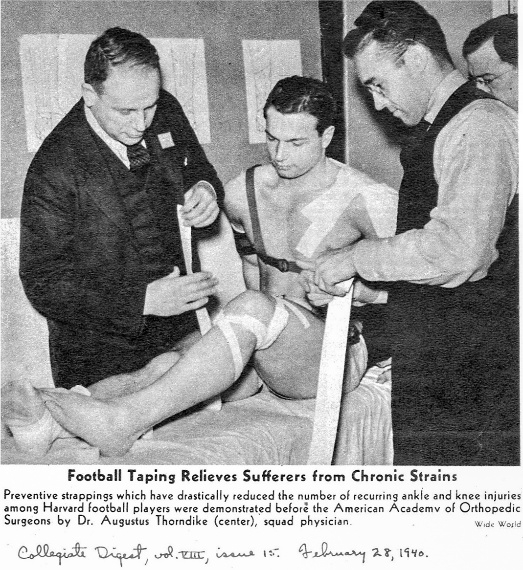
Dr. Thorndike took particular interest in injury prevention and management. He recommended exercises to increase the strength of the ankle and knee joints and advocated adhesive strapping of previously sprained joints to prevent reinjury.11 He created numerous taping and bandaging techniques and invented new braces and protective splints and casts, including a light, waterproof cast.25 He designed improved padding and protective gear for football players, including the suspension helmet. Dr. Thorndike was keenly aware of the effects of repeated head injuries and was the originator of the “three strike rule,” recommending athletes not be permitted to participate in body-contact sports if they have “suffered three cerebral concussions of moderate degree.“20 He was the first to recommend observation and hospitalization for at least 24 hours in “all cases of concussion presenting residual symptoms.”13 The combined efforts of coaches, trainers, and doctors under Dr. Thorndike’s direction dramatically reduced incidence of injuries in organized sports at Harvard College.13
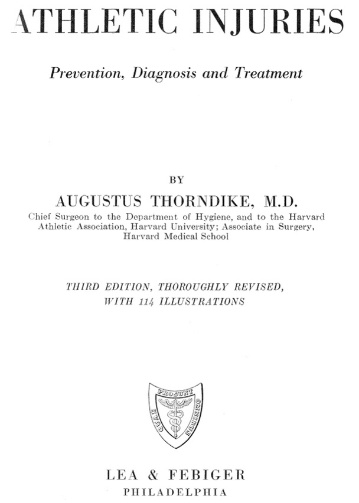
Dr. Thorndike was prolific in sharing his knowledge on sports medicine with the wider community, including publications in the New England Journal of Medicine.8,12,14–16,18,19,21-27 In 1933, at the request of the National College Athletic Association (NCAA), he, together with Edgar Fauver and Joseph Raycroft, wrote a medical handbook on the “Prevention and Care of Athletic Injuries.”6 Further, he published the first American sports medicine textbook: Athletic Injuries, Prevention, Diagnosis, and Treatment in 1938 (Figure 3).13 It was regarded as the definitive textbook on the subject, with five editions published between 1938 and 1962 and a reprint released in 2023.4,10 He also provided a demonstration on football taping at the 1940 American Academy of Orthopaedic Surgeons Annual Meeting (Figure 4), and published A Manual of Bandaging Strapping and Splinting, which followed the bandaging course he provided at Harvard Medical School.11
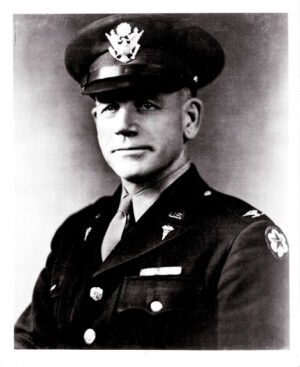
His care for patients’ injuries and their recovery extended beyond the athlete in his role as colonel in the United States Army during World War II (Figure 5), where he served as Chief of Surgical Services and Commanding Officer of the 105th General Hospital Harvard Unit in Australia.9 After the war, he was recruited by the Army Surgeon General to head the reconditioning division, caring for disabled veterans. He directed an initiative to provide artificial limbs for veterans and create devices and practical programs for disabled soldiers, receiving the Legion of Merit in 1945 for his work, which provided the basis for today’s sophisticated rehabilitation techniques and 21st century prosthetic devices.17
In 1953, at the request of the American Medical Association (AMA), Dr. Thorndike formed a committee to address sports injuries with Drs. Carl, Graeme Hammond, “Brick” Mueller, and Allen J Ryan, for which Dr. Thorndike served as the first chair.4,8 In 1957, the AMA Committee on Medical Aspects of Sports created a Bill of Rights of the Athlete which asserted every student athlete be entitled to good coaching, good equipment, and good medical care including a preseason history and examination, physician presence at games, and the unquestioned authority of team physicians regarding medical matters.5,8
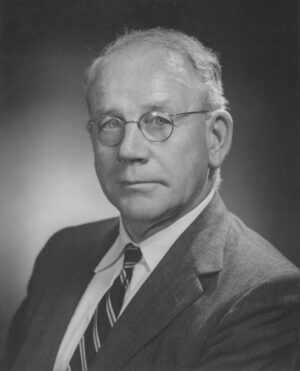
Dr. Thorndike retired in 1962 (Figure 6) and passed away in 1986. He left a legacy as the father of sports medicine in the United States through his dedication to providing thoughtful, comprehensive care to every patient, including Harvard athletes.
References
- Bachynski K. No Game for Boys to Play: The History of Youth Football and the Origins of a Public Health Crisis. University of Chapel Hill Press; 2019.
- Edwards HT, Thorndike A, Dill DB. The Energy Requirement in Strenuous Muscular Exercise. N Engl J Med. 1935;213(11):532-535. doi:10.1056/nejm193509122131108
- Farnsworth DL, Thorndike A. Health in Colleges and Universities. N Engl J Med. 1956;255(20):949-955. doi:10.1056/nejm195611152552006
- Martin J. Augustus Thorndike: Sportsmedicine Pioneer. Physician Sportsmed. 1978;6(5):127-130. doi:10.1080/00913847.1978.11710725
- Micheli LJ, ed. Encyclopedia of Sports Medicine. Vol 1. Sage; 2011.
- National Collegiate Athletic Association. National Collegiate Athletic Association Medical Handbook for Schools and Colleges:Prevention and Care of Athletic Injuries. 1933.
- Pembroke Record - Brown Digital Repository Collection. Collegiate Digest Vol. VIII, No. 15 (1940-2-28). Accessed January 29, 2024. https://repository.library.brown.edu/studio/collections/bdr:6z7c3a7f/
- Quigley TB. Contributions of Sports to Medicine. JAMA. 1966;197(11):883-884. doi:10.1001/jama.1966.03110110107023
- Rowe CR. Lest We Forget: Orthopaedics at the Massachusetts General Hospital, 1900-1995. Bauhan Publishing. 1996.
- Snook GA. The history of sports medicine. Part I. Am J Sports Med. 1984;12(4):252-254. doi:10.1177/036354658401200402
- Thorndike A. A Manual of Bandaging Strapping and Splinting. 1st ed. Lea & Febiger; 1941.
- Thorndike A. Athletic and Related Injuries. N Engl J Med. 1940;223(5):180-185. doi:10.1056/nejm194008012230504
- Thorndike A. Athletic Injuries: Prevention, Diagnosis and Treatment. 3rd ed. Lea & Febiger; 1948.
- Thorndike A. Frequency and nature of sports injuries. Am J Surg. 1959;98(3):316-324. doi:10.1016/0002-9610(59)90520-3
- Thorndike A. Management of common athletic injuries. J Natl Assoc Chirop. 1951;41(12):36-37.
- Thorndike A. Myositis Ossificans Traumatica. JBJS. 22(2).
- Thorndike A. New Technics and Materials in Upper-Extremity Prosthetics. N Engl J Med. 1952;247(26):1022-1033. doi:10.1056/nejm195212252472605
- Thorndike A. Prevention of Injuries in College Athletics. J Am Med Assoc. 1959;169(13):1405-1409. doi:10.1001/jama.1959.03000300001001
- Thorndike A. Prevention of Injury in Athletics. J Am Med Assoc. 1956;162(12):1126-1132. doi:10.1001/jama.1956.02970290022007
- Thorndike A. Serious Recurrent Injuries of Athletes — Contraindications to Further Competitive Participation. N Engl J Med. 1952;247(15):554-556. doi:10.1056/nejm195210092471504
- Thorndike A. The Trauma of Athletics. N Engl J Med. 1952;246(9):335-339. doi:10.1056/nejm195202282460905
- Thorndike A. Trauma Incident to Sports and Recreation. N Engl J Med. 1938;219(13):457-465. doi:10.1056/nejm193809292191301
- Thorndike A. Treatment of the more common athletic injuries. Med Clin North Am. 1950;34(5):1255-1269.
- Thorndike A, Dimmler CL. Fractures of the Forearm and Elbow in Children — An Analysis of Three Hundred and Sixty-Four Consecutive Cases. N Engl J Med. 1941;225(13):475-480. doi:10.1056/nejm194109252251301
- Thorndike A, Garrey WE. A Useful Type of Light, Waterproof Cast — Preliminary Report. N Engl J Med. 1938;218(5):205-211. doi:10.1056/nejm193802032180501
- Thorndike A, Garrey WE. Fractures of the Carpal Scaphoid. N Engl J Med. 1940;222(20):827-830. doi:10.1056/nejm194005162222001
- Thorndike A, Quigley TB. Injuries to the acromioclavicular joint A plea for conservative treatment. Am J Surg. 1942;55(2):250-261. doi:10.1016/s0002-9610(42)90194-6